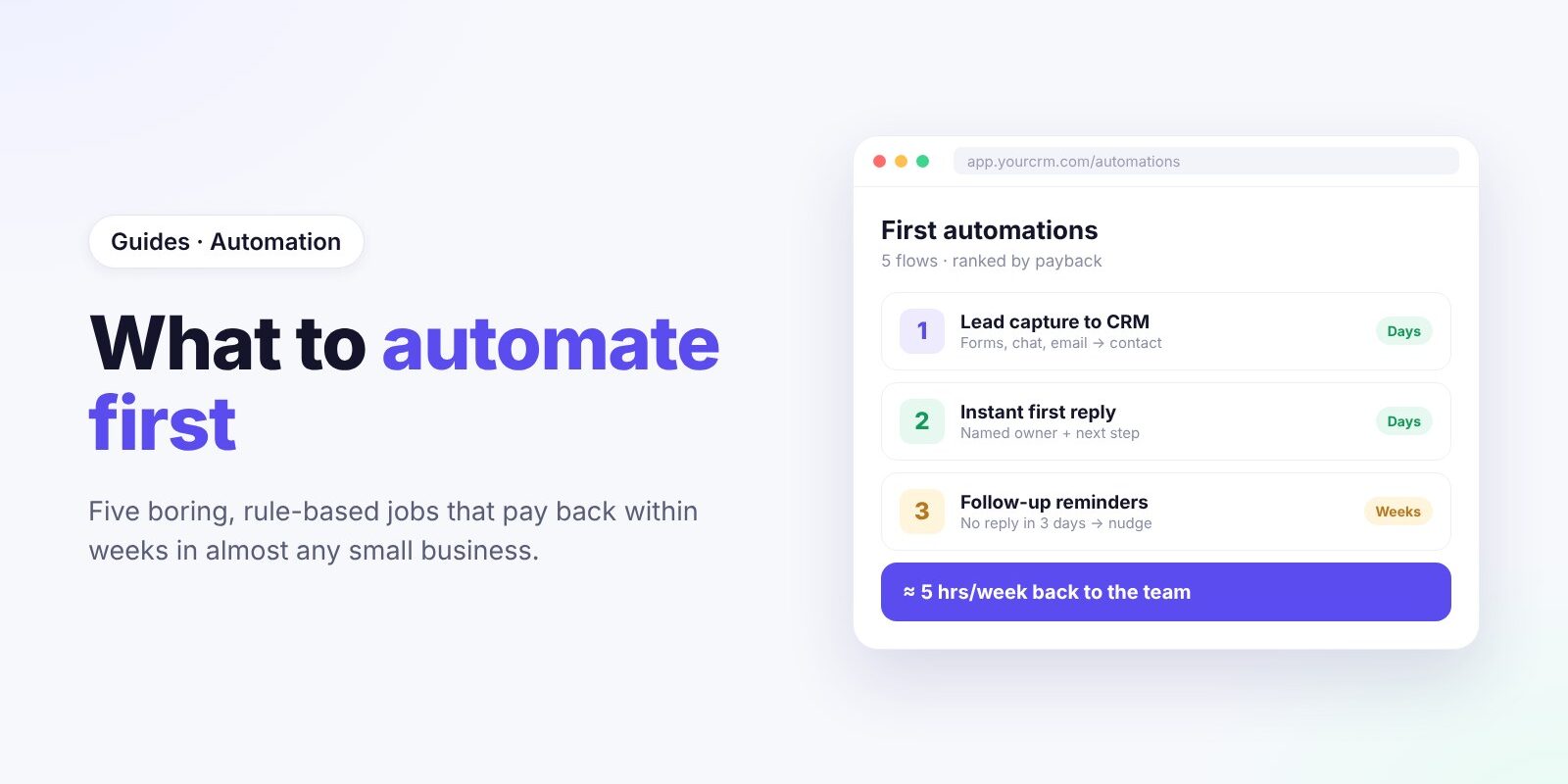
The best first automation is boring. It is frequent, rule-based and saves a little time many times a day, and nobody argues about what the right outcome is. Teams that start with something exciting – an AI agent that “runs sales”, a forty-step workflow across six tools – often spend months building and never see the payback. Teams that start with the dull jobs usually see results in the first week.
Below are five jobs that pay back quickly in almost every small business, how to automate each one, and a simple way to choose which to do first.
How to spot a good first automation
Before the list, a quick test. A task is a strong candidate if it scores “yes” on most of these:
- Frequent – it happens daily or many times a week.
- Rule-based – you could write the steps on one page without saying “it depends”.
- Digital at both ends – the input and output already live in software (a form, an inbox, a sheet, a CRM).
- Low risk – if it goes wrong once, the damage is small and easy to fix.
- Visible – people will notice the time saved, which builds support for the next project.
A rough payback check: minutes saved per run × runs per month ÷ 60 = hours saved per month. If that number is larger than the hours it takes to build, you are in profit within a month.
1. Lead capture to CRM
Every website form, chat conversation and inbound sales email should create or update a contact automatically, without anyone copying and pasting. This alone fixes a surprising problem: the leads that were never entered at all because someone was busy.
How: connect your forms and chat widget to your CRM directly or through a tool such as Zapier, Make or a short script. Match on email address to avoid duplicates, tag the source (“website form”, “chat”, “Google Ads”) and assign an owner by rule – for example by region or product.
Payback: immediate. You stop losing leads and gain reliable data on which channels actually bring customers.
2. The first reply
Speed of first response is one of the strongest predictors of winning an enquiry. An immediate, useful acknowledgement – with the next step and a real person’s name – keeps a new lead warm until someone picks it up.
How: trigger an email or WhatsApp message the moment the lead is created. Keep it short, specific and human: confirm what they asked for, set expectations (“Priya will call you before 4pm today”), and include a booking link if a call is the next step. AI can help draft a tailored reply from the enquiry text, but keep a human-approved template as the fallback.
Payback: higher conversion from the same traffic, without hiring.
3. Follow-up reminders
Most deals do not end with a “no”. They quietly die because nobody followed up. If a quote has had no answer in three days, the owner should get a nudge automatically.
How: in your CRM, create a rule: when a deal enters “Quote sent” and has no activity for three days, create a task for the owner and send them a reminder. Add a second rule at seven days that alerts a manager. For simple cases you can even send the client a polite automated check-in.
Payback: deals recovered that would otherwise have been forgotten – often the single highest-value automation a sales team can build.
4. The weekly report
If someone spends Monday morning building the same report – leads by source, deals won, open tickets, revenue against target – it can build itself and arrive by email before anyone is at their desk.
How: most CRMs and help desks have scheduled reports. If your data lives in Google Sheets, a short Apps Script can calculate the figures and email a summary on a timer. Send fewer numbers, not more: five figures people act on beat a twenty-tab dashboard nobody opens.
Payback: one to three hours a week returned to someone senior, and decisions made on current numbers.
5. Handoffs between tools
The gaps between systems are where work gets stuck: a won deal that never becomes an invoice, a signed form that never triggers onboarding, a support ticket that should have created a refund. Each handoff is small, but together they cost hours and create errors.
How: list your handoffs on paper first – “when X happens in tool A, someone does Y in tool B”. Then automate the most frequent one. Typical examples:
- Deal marked “Won” in the CRM → invoice drafted in the accounting tool.
- Order placed in the store → customer added to the CRM and a welcome sequence (see AI automation for Shopify stores).
- Contract signed → project created with the standard task list and the client invited.
- New employee added to HR → accounts requested and a first-week checklist created.
Payback: fewer dropped balls, faster cash collection and less double entry.
Which one should you do first?
| Automation | Typical effort | Time to payback | Best for |
|---|---|---|---|
| Lead capture to CRM | Low | Days | Any business with a website |
| First reply | Low | Days | Service businesses, agencies, B2B |
| Follow-up reminders | Low–medium | Weeks | Teams that send quotes |
| Weekly report | Low–medium | Weeks | Owners and managers |
| Handoffs between tools | Medium | Weeks | Teams using three or more tools |
If you are unsure, start with lead capture and the first reply together. They are quick, they touch revenue directly, and they create the clean contact data every later automation depends on.
Mistakes to avoid
- Automating a broken process. If nobody agrees how a task should be done, automation just makes the confusion faster. Fix the steps first.
- Skipping the owner. Every automation needs a named person who checks it is still working.
- No alerts on failure. Make sure someone is told when a step fails, rather than discovering it weeks later.
- Too much at once. Ship one automation, measure it for two weeks, then move to the next.
Getting started this week
- List every repetitive task the team does, with roughly how often and how long it takes.
- Score each against the five-point test above.
- Pick the top one, build the simplest version, and measure the time saved.
- Share the result with the team, then pick the next.
Want a second opinion on your list? Send it to us and we will suggest the two automations most likely to pay back first.
2 comments