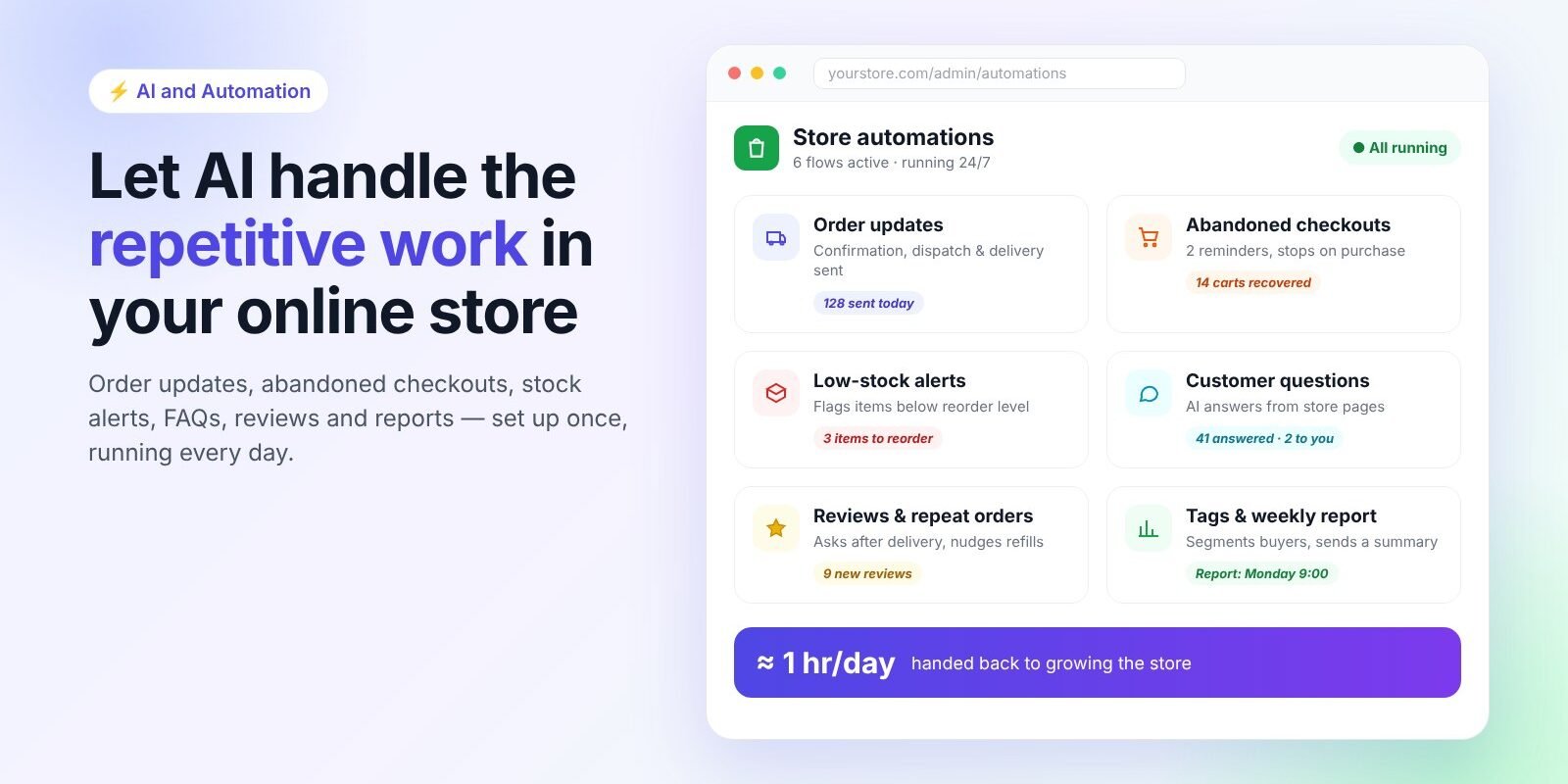
A small Shopify store does not usually fail because the products are bad. It stalls because the owner spends the day doing the same small jobs over and over: confirming orders, chasing carts, answering “where is my order?”, checking stock, and sending the same message for the tenth time. None of that work sells anything. It just keeps the store standing still.
AI automation does not replace the owner. It takes the repetitive half of the day and does it the same way every time, so the owner can spend the other half on the work that actually grows the store: better products, better photos, better offers. Here is where it helps most, in the order a small store usually feels the pain.
1. Order confirmations and status updates
The first job automation takes is the one customers expect instantly. When an order is placed, the store should confirm it, and when the parcel moves, the customer should know without asking. An automated flow sends the confirmation, the dispatch note and the delivery update at the right moment, with the order number and tracking link already in it.
The gain is not only speed. It is consistency. A tired owner forgets a message at 11 pm; a flow does not. And every “has my order shipped?” message that never arrives is a support ticket the owner never has to answer. For a store taking daily orders, that alone can return an hour a day.
2. Abandoned checkouts
Most shoppers who reach checkout do not finish it. They get distracted, they want to compare prices, or the delivery charge surprises them. A short, well-timed sequence — one reminder, then one more with a reason to come back — recovers a real share of those orders.
The mistake is to automate the sending and forget the message. A reminder that only says “you left something behind” is easy to ignore. One that names the product, answers the likely objection and makes the next step one tap will do far better. Automation handles the timing; the owner still has to write a message worth opening. Set the delay, the number of messages and the stop rule once — when the order is completed, the flow stops — and it runs for every cart after that.
3. Inventory and low-stock alerts
Nothing damages a small store faster than selling something that is not there. A customer pays, the owner discovers the shelf is empty, and the refund comes with an apology and a lost customer. Low-stock alerts fix this quietly: when a product falls below a level the owner sets, the system flags it before the next order arrives.
For stores with variants — sizes, colours, bundles — this matters more, because one popular size can sell out while the listing still looks available. Automation can also hide or tag the sold-out variant, so shoppers see what they can actually buy. The owner still decides when to reorder; the system just makes sure the decision is made in time.
4. Answering the same questions
Read a store’s inbox for a week and the same five questions appear again and again: delivery time, delivery charge, return policy, size help, and “where is my order?”. An AI assistant trained on the store’s own pages — its shipping, returns and product details — can answer those directly, day or night, and hand over to a human when the question is unusual, angry or about a payment.
The rule that keeps this honest is simple: the assistant answers from the store’s real information, and it says so when it does not know. A wrong answer delivered instantly is worse than a slow right one. Done well, the inbox shrinks to the messages that actually need a person — complaints, custom orders, wholesale enquiries — and those get a faster, better reply because the owner is no longer buried in the routine ones.
5. Review requests and repeat orders
A store that never asks for reviews gets few of them, and a store that asks at the wrong moment gets ignored. Automation solves the timing: a few days after delivery, when the customer has actually used the product, a short request goes out. Happy customers leave the review; unhappy ones reply to the store first, which is a second chance to fix the problem before it becomes a public one-star review.
The same logic works for repeat orders. A customer who bought a consumable — skincare, coffee, pet food — does not need a sales pitch; they need a nudge when they are likely to run out. A simple replenishment reminder, sent once and only to past buyers of that product, brings orders back without discounting. It is the cheapest marketing a store has, because the customer already trusts it enough to have bought once.
6. Tagging, segments and reporting
Behind the visible messages, automation keeps the store’s records honest. Every order can tag the customer — first-time buyer, repeat buyer, high value, bought a particular collection — and those tags build segments the owner can actually use. Instead of emailing everyone about everything, the store emails the right group: new buyers get the welcome story, repeat buyers get early access, and one-time buyers of a seasonal product are not bothered in the off-season.
Reporting gets the same treatment. A weekly summary — orders, best sellers, abandoned carts recovered, questions answered — lands in the owner’s inbox without anyone building a spreadsheet. The point is not more data; it is one short read that shows what changed and what needs attention.
Where to start with Shopify AI automation — and what not to automate
A store does not need all of this on day one. Start with the job that eats the most time. For most small stores that is order-status messages, then abandoned checkouts, then the repeated questions. One flow at a time, checked for a week, fixed where it sounds wrong, and only then the next one. Automation built in a rush sounds like a robot; automation built one flow at a time sounds like a well-run shop.
And some things should stay manual. A complaint, a custom order, a wholesale enquiry and a loyal customer with a problem all deserve a person. The test is simple: if the answer is the same every time, automate it. If the answer depends on judgement, keep it human. Stores do not lose customers because a confirmation email was automated. They lose them when the human moments are automated too.
The repetitive work will never disappear from a Shopify store. But it does not have to be done by the owner, one message at a time, forever. Set the flows up once, check them weekly, and give the hours back to the work only a person can do.