Updated November 14, 2026. This story is moving fast, and we’ll refresh it as NVIDIA names a permanent CEO and reports earnings.
Few people expected the AI chip war to take its sharpest turn in a boardroom. But on November 12, 2026, Jensen Huang stepped down as CEO of NVIDIA, the company he co-founded in 1993 and turned into the backbone of the AI boom. His exit followed days of reporting that linked him to a woman alleged to have ties to Chinese intelligence, and it landed right in the middle of Washington and Beijing’s long fight over who gets the world’s best AI hardware.
So this isn’t really a story about one executive. It’s about who controls the chips every AI model needs to run. Below, we break down what happened, how much NVIDIA has lost in China, which Chinese chipmakers are stepping in, and what the whole thing means for the rest of the world, India included.
Why NVIDIA sits at the centre of the AI chip war
NVIDIA holds roughly 90% of the market for advanced AI chips, according to Al Jazeera. Its GPUs train and run the big models behind chatbots, coding assistants, search and image tools, and cloud giants buy them by the tens of thousands.
The hardware is only half the story. Back in the mid-2000s NVIDIA launched CUDA, a software layer that lets developers use its GPUs for general computing. Twenty years on, most AI research code is written with CUDA in mind, so moving to another vendor’s chip is slow and costly.
A simple way to picture it: the GPU is the engine, and CUDA is the gearbox every mechanic already knows. That pairing helped lift NVIDIA’s revenue from $4.13 billion in fiscal 2014 to $215.9 billion in fiscal 2026.
US export controls: less a wall, more a gate with two locks
Since 2022, the US has limited China’s access to advanced AI chips and chipmaking equipment, on the grounds that they could boost China’s military and surveillance capabilities. The rules have changed many times since then.
Lock one sits in Washington. In December 2025, President Trump allowed limited sales of NVIDIA’s H200 to China. In January 2026 the Commerce Department moved H200 licences to case-by-case review, with a 25% tariff, volume caps and buyer checks. The newer Blackwell chips, like the B200 and B300, are still off the table.
Lock two sits in Beijing. Around 600,000 H200 chips are reportedly stuck in Hong Kong because China hasn’t approved large-scale imports. Beijing wants its companies buying local.
| NVIDIA chip | Can it be sold in China? |
|---|---|
| Blackwell (B200, B300) | No. Blocked by US rules |
| H200 | Only with a US licence, a 25% tariff and Chinese import approval |
| Lower-end products (e.g. RTX Pro 5500) | Yes, cleared to ship |
And the gate leaks. The New York Times reported on November 7 that some Chinese firms approved to receive H200s couldn’t be confirmed as real, operating businesses.
Jensen Huang’s resignation: five days that ended a 33-year run
Things moved quickly. On Sunday, November 8, Huang admitted to being unfaithful to his wife and apologised to his family and staff. The first reported relationship was with a former executive at a Singapore-based tech firm who is alleged to have worked for Chinese intelligence. NVIDIA’s board backed him at first and opened an independent investigation into whether he’d been targeted by a foreign intelligence operation.
By Wednesday, the New York Times was reporting a second affair, this time with a senior NVIDIA executive who reported directly to him. On Thursday, November 12, NVIDIA announced that Huang was leaving as CEO and as a board member, effective immediately. CFO Colette Kress became interim CEO, and long-serving director Harvey Jones became board chair.
It’s worth being careful about what’s known and what isn’t. Huang acknowledged an affair. The espionage angle is still an allegation under investigation. NVIDIA’s board says it has no reason to think national security was compromised, China has denied any spy plot and called the reports a smear, and NVIDIA hasn’t given a reason for his departure.
The politics are tense because Huang spent years lobbying against tighter chip restrictions on China. Lawmakers are now looking at the national-security side, and CNN reports he has been summoned to testify before Congress.
What NVIDIA is losing in China
NVIDIA is getting hit in three places at once: its share price, its China sales, and its long-term place in the world’s second-biggest AI market.
The stock. Shares closed down 4.34% on November 12 after dropping more than 14% during the session, and they’d already slid over 20% the month before. That’s lost market value, not cash out the door. AMD and Broadcom rose as investors shuffled money around.
China sales. IDC figures reported by Reuters show NVIDIA shipped 678,000 AI accelerators in China in the first half of 2026, down 44% year on year. Its share of China’s data-centre AI chip market fell to 34%, from about 55% across 2025. Huawei shipped 572,000 units, up from just over 300,000, for a 28% share.
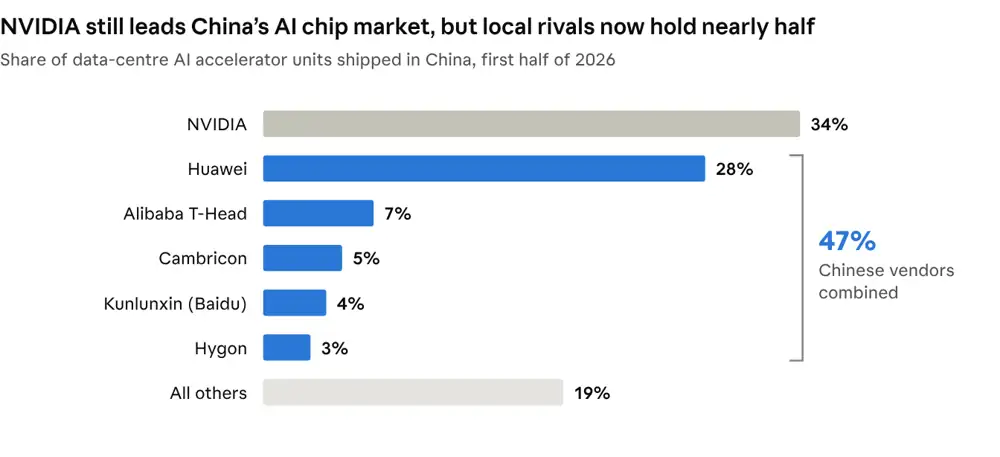
NVIDIA is still the biggest single vendor, but the Chinese companies IDC tracks now hold close to half the market between them. IDC also expects total accelerator shipments in China to grow 19% in 2026 while GPU shipments fall 9%. The pie is getting bigger; NVIDIA’s slice isn’t.
The long game. NVIDIA’s guidance already assumes zero data-centre revenue from China. The deeper worry is strategic: every Chinese lab that learns to train on home-grown chips is a customer that may not return, even if the rules relax.
How China is turning chip restrictions into an industry
Beijing is treating US controls as a push to build its own chip sector rather than a dead end. Holding back H200 approvals nudges demand toward local suppliers. Four names matter most:
| Company | Chip line | Role in China’s push |
|---|---|---|
| Huawei | Ascend AI processors, made at SMIC | The main NVIDIA alternative; shipments nearly doubled in a year |
| Alibaba | T-Head in-house chips | Designs chips for its own cloud |
| Cambricon | Dedicated AI processors | Pure-play AI chip designer |
| Baidu | Kunlun (Kunlunxin) AI chips | Runs Baidu’s own AI infrastructure |
You can see the shift in the hardware mix too. IDC found that non-GPU accelerators (the custom chips Chinese firms are building) jumped nearly 80% to 1.016 million units and overtook GPUs for the first time.
Put yourself in the shoes of an AI startup in Shenzhen. You can’t reliably buy NVIDIA’s latest GPUs, so you either stop building or you switch to local chips and rewrite your software. Most are doing the latter, and that creates a loop: more local demand, more state funding, better products, more developers tuning for local hardware.
That said, China hasn’t cracked the problem. Building leading-edge chips without advanced Western tools is hard, Huawei’s output is limited by capacity, and its CANN software stack is years behind CUDA. Chinese firms still want NVIDIA hardware: Reuters reports that AI data-centre projects worth more than $3.2 billion built on restricted NVIDIA chips are under way across China. Winning market share isn’t the same as winning on technology.
Five ways the AI chip war will reshape the industry
- Hardware competition gets fiercer. For years NVIDIA’s speed plus CUDA made it the obvious pick. Now China has every reason to fund alternatives, and US rivals like AMD get more room as investors question NVIDIA’s leadership.
- Compute could get cheaper, eventually. More chipmakers usually means more price pressure. Cheaper training and inference would help smaller companies build their own AI products, though that’s a long-term possibility, not an overnight price cut.
- Software becomes the real battleground. A fast chip is useless without the tools developers rely on. China’s challenge isn’t only making processors; it’s building an ecosystem that can stand next to CUDA.
- The AI world may split in two. A US-led stack (NVIDIA GPUs, CUDA, US suppliers) and a China-led stack (Huawei Ascend, CANN, domestic suppliers) are drifting apart. They still overlap today, but each new restriction widens the gap.
- Innovation could speed up. Rivalry pushes investment into data centres, robotics, self-driving cars, science and defence. The long-term winner may be whoever builds the most efficient full stack of chips, software, energy and infrastructure, not whoever makes the single fastest chip.
What the AI chip war means for India
India isn’t a direct party to this fight, and that’s exactly why it has room to gain. As global companies look to spread supply chains away from the US–China fault line, four openings stand out:
- Chip manufacturing and packaging. Firms looking for a neutral, trusted place for assembly, testing and fabrication have a reason to look at India.
- AI infrastructure. Data centres and GPU cloud capacity built in India can serve local startups and global customers alike.
- AI software and applications. India doesn’t need the world’s fastest GPU to win. Enterprise AI tools, automation, and models tuned for Indian languages and industries are a huge opportunity on their own.
- Skills and jobs. Demand keeps rising for people who understand machine learning, GPU computing, cloud infrastructure, model deployment and semiconductor engineering.
For anyone building a career in applied AI, the takeaway is simple: knowing the hardware and infrastructure under a model is becoming as valuable as knowing the model itself.
You also don’t need your own chips to benefit from cheaper AI. Plenty of the value lands in everyday business tools. For example, Convo uses AI to turn a WhatsApp Business number into a shared customer inbox that can draft replies and answer when your team is away.
Who’s winning and who’s losing right now
| Player | Where it stands |
|---|---|
| NVIDIA | No permanent CEO, shut out of most China sales, still the global AI chip leader |
| Huawei | Biggest winner from China’s push for domestic chips |
| Chinese AI labs | More local options, but still reliant on NVIDIA-class compute |
| US government | Holding firm on Blackwell, facing questions on licence enforcement |
| AMD and other rivals | A real opening to win customers and investor attention |
| India | A chance to build its own chip and AI ecosystem |
China isn’t automatically a winner from Huang’s fall, either. If the scandal pushes Washington toward tighter rules, Chinese labs that still depend on NVIDIA hardware lose too.
Timeline: how we got here
| Date | What happened |
|---|---|
| Nov 12, 2026 | Huang resigns; Colette Kress named interim CEO; shares close down 4.34% |
| Nov 8, 2026 | Huang admits an affair; NVIDIA opens an investigation into a possible foreign intelligence effort |
| Nov 5, 2026 | Reuters reports about 600,000 H200s held in Hong Kong awaiting Chinese approval |
| Oct 13, 2026 | IDC data puts NVIDIA’s China share at 34%, Huawei at 28% |
| Jan 2026 | US moves H200 licences to case-by-case review with a 25% tariff |
| Dec 2025 | Trump allows limited H200 sales to China |
| 2022 | US begins sweeping controls on advanced chips to China |
| 1993 | Jensen Huang co-founds NVIDIA |
Frequently asked questions
What is the AI chip war?
It’s the contest between the US and China over who can make, buy and control the advanced chips that train and run AI models. It plays out through export controls, import approvals and a race to build domestic alternatives.
Why did Jensen Huang resign from NVIDIA?
NVIDIA didn’t give a reason. His exit came after he admitted to an affair and after reports of a second relationship with a senior employee. Separate allegations that one partner had links to Chinese intelligence are still under investigation and have been denied by China.
Who is NVIDIA’s interim CEO?
Chief Financial Officer Colette Kress is serving as interim CEO while the board searches for a permanent replacement.
Can Huawei replace NVIDIA in China?
Huawei is gaining fast, with 28% of China’s AI accelerator market in early 2026. But it’s limited by manufacturing capacity and a less mature software stack, so Chinese labs still want NVIDIA chips where they can get them.
The bottom line
Three battles are running at the same time. A business one, as NVIDIA tries to keep selling globally while China builds its own chips. A geopolitical one, as the US protects its tech lead and China chases independence. And a technology one, as both sides race for better models, faster processors and cheaper compute.
The future of AI won’t be decided only by who builds the smartest model. It’ll be decided by who controls the chips, factories, software, energy and data centres those models run on. That’s why the AI chip war matters far beyond one company or one CEO.
The next big test comes on November 17, when NVIDIA reports third-quarter fiscal 2027 results, its first under interim leadership.
1 comment