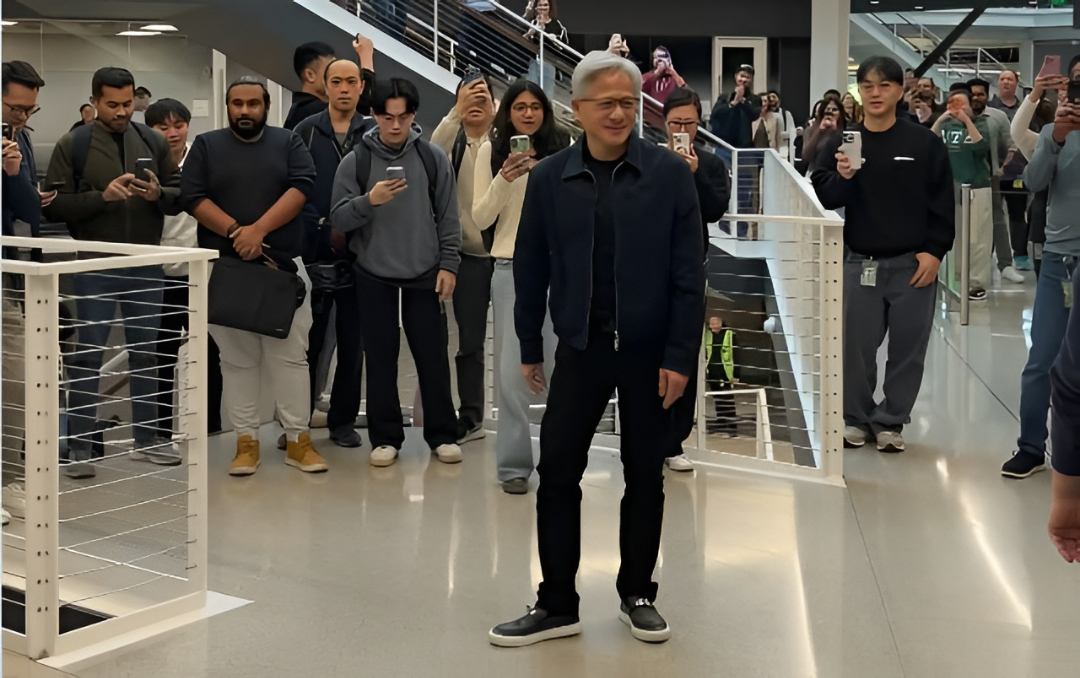
In less than two weeks, Nvidia went from announcing the sudden exit of its founder to bringing him back with a unanimous board vote. Jensen Huang reinstated as president and CEO on November 23, 2026, closing one of the strangest chapters in recent corporate history and leaving investors, policymakers, and AI watchers with a long list of open questions. This article walks through what happened, why the board changed course, how the market reacted, and what still needs answering.
A note on sourcing: this is a fast-moving story, and parts of it involve allegations that have not been proven. Where something comes from Nvidia’s own filing, I say so. Where it comes from news reporting, I attribute it. Where it is analysis or opinion, I label it as such.
The Short Version: Jensen Huang Reinstated After Resignation
On Monday, November 23, Nvidia announced that its board had voted unanimously to reinstate Huang as president and CEO, and as a member of the board, effective immediately. The announcement was filed with the SEC. Colette Kress, who had served as interim CEO since Huang’s departure, returns to her role as chief financial officer. Harvey C. Jones continues as board chair.
The reversal came just over 10 days after Huang resigned on November 12. That is an extraordinary pace for a company worth trillions of dollars. Boards rarely reverse a CEO resignation at all, let alone within days.
How the Jensen Huang Resignation Unfolded
The story began on November 8, when, according to reporting by TechCrunch, Huang acknowledged an affair in a message to Nvidia employees, and the board opened an investigation. Over the next several days, further reports surfaced. The New York Times reported that Huang had also had a relationship with an Nvidia executive who reported to him, and the Wall Street Journal reported that the board was preparing to meet about his future. Nvidia’s stock fell as that news spread.
On November 12, Nvidia announced that Huang had resigned and that Kress would serve as interim CEO while the board searched for a permanent successor. Major outlets, including ABC News and Al Jazeera, described the resignation as coming after reports of at least two extramarital relationships, one involving a woman suspected by U.S. officials of ties to Chinese intelligence. China has denied the allegation. Not all details have been independently confirmed, and some outlets have reported additional claims that I have not repeated here because the sourcing is thinner.
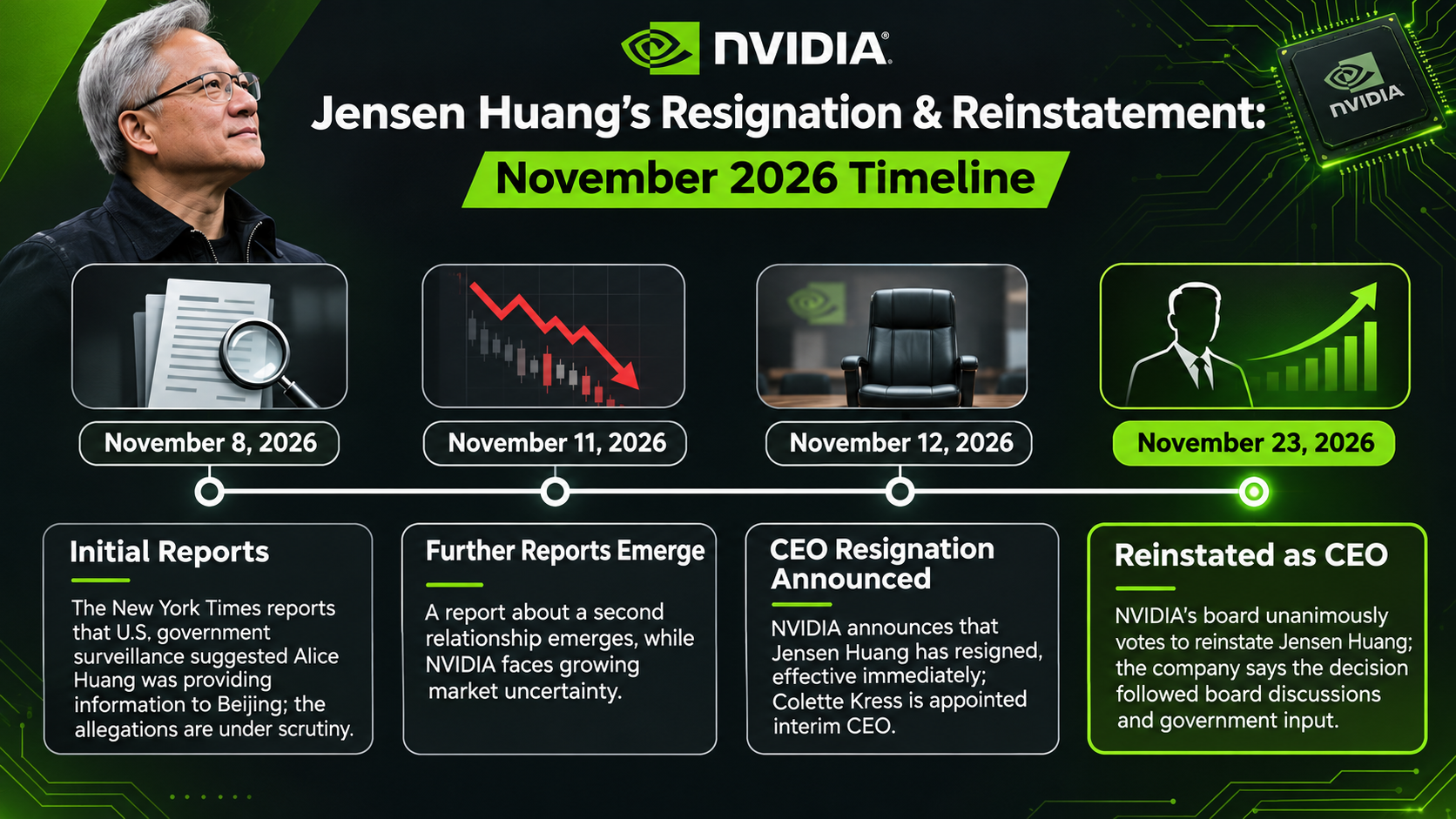
| Date (2026) | Development |
|---|---|
| November 8 | Huang acknowledges an affair in a message to staff; the board begins an investigation |
| November 11 | Further reports about a second relationship; Nvidia shares fall |
| November 12 | Huang resigns; Colette Kress named interim CEO |
| November 23 | Board votes unanimously to reinstate Huang; shares surge |
Why Was Jensen Huang Reinstated? The Board’s Stated Reasons
Nvidia’s official explanation is short and carefully worded. In its press release, the company said the board reached its decision after a series of discussions and meetings with Huang, and that it was satisfied with his candor and his ability to lead Nvidia. The board also said it had received input from senior levels of the U.S. government and, based on that input, was confident that his return poses no national security risk.
The company added that the board had formed a committee of independent directors, with outside counsel, to investigate the reports that Huang was the target of a foreign intelligence effort. That investigation is not over. Nvidia said it will continue to conclusion, and that Huang supports it and will cooperate.
In other words, the reinstatement is not a finding that every question has been answered. It is a decision by the board that, for now, Huang should lead the company while the review continues.
Did Trump Influence the Decision?
This is the question readers ask most, and it deserves a careful answer. The facts are these. President Trump publicly backed Huang’s return, and said he had been in contact with the board. After the announcement, he called the decision correct and proper on social media and said, in his own account, that the attorney general had told him the government has no evidence of unlawful conduct by Huang.
What is less clear is how much his pressure actually mattered. Some outlets described the reinstatement as following Trump’s intervention. One analysis noted that the sequence shows presidential involvement but does not by itself prove that his pressure decided the outcome. Reporting also pointed to support from employees, shareholders, business partners, and other technology leaders, and Elon Musk was among the prominent voices reported as backing Huang’s return.
My own reading, which is opinion and not established fact, is that several forces converged at once. A leaderless Nvidia was becoming a market-wide problem, the government signaled that it did not see a security risk, and the board had a face-saving path back. Whether that path was the right one is something reasonable people will debate, and some lawmakers have already said they want more answers.
Nvidia Stock After Jensen Huang Reinstated
The market’s verdict was loud. After the announcement, Nvidia shares jumped roughly 30% in early trading on Monday, according to CBS News and others, and some outlets reported gains above 33% during the session, with the stock trading around the high $160s. Reporting put the one-day addition to Nvidia’s market value at more than a trillion dollars, which essentially recovered what had been lost after the resignation.
The exact percentage varies by outlet because it depends on the time of day and the reference price, so treat any single figure with some caution and check a live quote before citing it. What does not vary is the direction and the scale. Analyst Dan Ives of Yorkville Ives told CBS News that the board effectively had no choice, because the resignation was turning into a broader economic and market issue. That is the view of one analyst, but it captures the mood well.
What Huang’s Return Means for Nvidia’s AI Business
For customers and partners, the most immediate effect is continuity. Huang has led Nvidia since he co-founded it in 1993, and he has been the company’s public face and chief strategist as it grew from a graphics chip maker into a central supplier of AI computing hardware. Having him back at the helm removes the uncertainty of a CEO search at a moment when major AI customers are planning large, multi-year purchases.
But continuity is not the same as a clean slate. Three issues will probably shape the next few months. The first is the outcome of the board’s independent investigation, since a finding could change the picture quickly. The second is continuing scrutiny from government officials and lawmakers over China-related risk and export controls, an area where Nvidia was already under pressure. The third is governance: the episode showed how much of the company’s identity, and its stock price, rests on one person.
That last point is an opinion, but it is a widely shared one among market observers. When a single executive can move a company’s value by hundreds of billions of dollars in a week, investors tend to ask about succession planning and board independence, whatever the company’s other strengths.
Frequently Asked Questions About the Jensen Huang Reinstatement
Was the board vote unanimous?
Yes. Nvidia’s own release says the board voted unanimously to reinstate Huang.
What roles did Huang regain?
He returned as president, chief executive officer, and a member of the board of directors. Kress went back to her full-time CFO role.
Is the national security question settled?
Not entirely. The board said it is confident, based on input from senior U.S. government officials, that his return poses no national security risk. At the same time, its own investigation into the alleged foreign intelligence effort continues, and some political and media scrutiny has not gone away. The underlying allegations have been publicly denied by China and remain contested in the political debate.
Could Huang be removed again?
Yes, in principle. A CEO serves at the board’s discretion, so new facts from the investigation, regulators, or legal proceedings could change his position. That is general corporate governance, not a prediction about what will happen.
Is Huang still Nvidia’s founder?
Yes. He co-founded Nvidia in 1993, and the reinstatement does not alter that history.
What happens after Jensen Huang reinstated?
The next milestones to watch are the board committee’s findings, any congressional or regulatory follow-up, Nvidia’s next earnings report, and whether the stock holds its gains once the initial relief fades.
Conclusion: A Return With Conditions
Jensen Huang reinstated is the headline, but the more useful story is the one underneath it. Nvidia’s board concluded within days that the company needed its founder more than it needed distance from the controversy, and the market agreed emphatically. What it did not do is close the investigation, quiet the political argument, or answer the question of how a company this important depends on one person.
If you follow Nvidia as an investor, a customer, or simply as someone curious about where AI is heading, keep an eye on the board committee’s findings and on Nvidia’s next official filings. Bookmark Nvidia’s investor relations page and the SEC filings page, and check back as the facts develop. This story is not finished.