Imagine starting your working day and discovering that you cannot access your emails, schedule meetings, or communicate with colleagues. For millions of users, this became a reality on November 12, 2026.
The Microsoft Outlook outage of 2026 disrupted access to Outlook, Exchange Online, Microsoft Teams, Copilot, and several other Microsoft 365 services. The disruption spread across 74 countries and territories, affecting businesses, government organisations, financial institutions, healthcare services, and other industries.
According to reporting based on Downdetector and its parent company Ookla, more than 7.4 million outage reports were recorded worldwide.
But what actually happened behind the scenes? Why did Microsoft’s infrastructure fail, how much could the incident cost, and what does it reveal about the world’s dependence on cloud technology?
Let’s investigate.
Microsoft Outlook Outage 2026: What Happened?
The disruption began on November 12, when users started experiencing problems accessing Microsoft Outlook and Exchange Online.
Users reported several issues, including:
- Inability to open email inboxes.
- Delayed or unsuccessful email delivery.
- Problems accessing calendars and scheduling meetings.
- Microsoft Teams connectivity issues.
- Disruptions to Microsoft 365 applications.
- Problems with some Copilot and connected integrations.
Microsoft services affected by the outage
| Microsoft service | Reported impact |
|---|---|
| Outlook | Email access and delivery problems |
| Exchange Online | Mailbox connectivity disruption |
| Microsoft Teams | Some connectivity and meeting-related issues |
| Microsoft 365 | Multiple connected services affected |
| Microsoft Copilot | Some access and integration problems |
| SharePoint Online | Some connected functions affected |
| OneDrive | Some connectivity and dependent functions affected |
The outage did not affect every customer or application equally. Some services continued working normally, while others experienced partial or complete disruption.
According to The Guardian, the disruption continued for roughly 18 hours before broader recovery became visible. However, service restoration remained gradual, with some problems continuing beyond that initial period.
Why this matters: Microsoft 365 applications are used by more than 430 million people, according to figures reported by The Guardian. Even a temporary interruption can affect an enormous number of organisations.
Sources: Reuters | The Guardian
Why Did Microsoft Outlook Go Down?
The Microsoft Outlook outage was linked to a technical problem involving Microsoft’s network infrastructure and server availability.
Microsoft’s preliminary investigation indicated that an issue introduced during an earlier network capacity upgrade surfaced following a subsequent network change.
In simple terms, some servers unexpectedly became unavailable. This shifted additional workloads onto the remaining infrastructure, increasing pressure on servers that were still operating.
How did the technical failure happen?
| Stage | What happened |
|---|---|
| 1. Network upgrade | An earlier infrastructure change introduced an underlying issue |
| 2. Configuration change | A subsequent network change exposed the problem |
| 3. Server failure | Some servers became unexpectedly unavailable |
| 4. Increased load | Remaining servers handled additional traffic |
| 5. Recovery difficulties | Some restored servers became unresponsive when traffic returned |
| 6. Service restoration | Microsoft applied fixes and gradually restored infrastructure |
Understanding the infrastructure failure
Imagine a highway with 100 lanes. Suddenly, 30 lanes become unavailable.
The remaining 70 lanes must handle traffic previously distributed across all 100 lanes.
Congestion increases, traffic slows down, and additional problems may develop.
This is a simplified illustration of how infrastructure failures can create cascading effects.
Microsoft said the incident was not related to a cyberattack or AI agents. Its investigation also involved examining configuration changes and improving server recovery.
The important lesson: A problem affecting one part of a large cloud infrastructure can create additional pressure on other parts of the same system.
Source: Microsoft incident updates | The Guardian – Technical explanation
How Much Did the Microsoft Outage Cost?
A global cloud outage creates financial consequences beyond the technology provider itself.
Businesses can lose productive working hours, delay transactions, miss communication deadlines, and struggle to serve customers.
According to Reuters, Morningstar DBRS estimated global insured losses from the incident at approximately $300 million to $500 million.
However, this figure requires an important distinction.
It represents estimated insured losses, not Microsoft’s confirmed financial loss or the total economic damage caused by the outage.
Financial impact breakdown
| Financial category | Estimated status |
|---|---|
| Global insured losses | $300–500 million, analyst estimate |
| Microsoft’s direct financial losses | Not publicly confirmed |
| Business productivity losses | No complete official calculation |
| Lost business revenue | Not officially calculated |
| Total worldwide economic damage | Unknown |
How much can business downtime cost?
Consider a hypothetical company with 500 employees.
Assumptions:
- Employees affected: 500
- Reduced productivity: 4 hours
- Average employee cost: $20 per hour
Calculation:
500 × 4 × $20 = $40,000
The company could experience approximately $40,000 in productivity costs under these assumptions.
This is an illustrative calculation, not an actual loss reported during Microsoft’s outage.
Estimated productivity cost by company size
| Employees | Estimated cost |
|---|---|
| 50 | $4,000 |
| 100 | $8,000 |
| 500 | $40,000 |
| 1,000 | $80,000 |
| 5,000 | $400,000 |
Assumption: Four hours of reduced productivity at $20 per employee per hour. These figures are illustrative, not verified outage losses.
The calculation demonstrates how quickly downtime costs can increase as organisations grow.
The bigger picture: The financial impact of a technology outage is not limited to the company operating the infrastructure. Every dependent organisation can experience its own operational and financial consequences.
Source: Reuters – Microsoft’s global outage and financial impact
How Did the Microsoft Outlook Outage Disrupt the World?
The Microsoft Outlook outage affected organisations across several industries, demonstrating how dependent modern operations have become on cloud-based communication.
The Associated Press and other news organisations reported disruptions involving healthcare services, pharmacies, government agencies, and financial organisations.
In the UK, NHS-related systems experienced disruption. Some healthcare employees turned to paper records and alternative procedures when they could not access their usual digital tools.
Government organisations in several countries also reported problems.
Impact across different industries
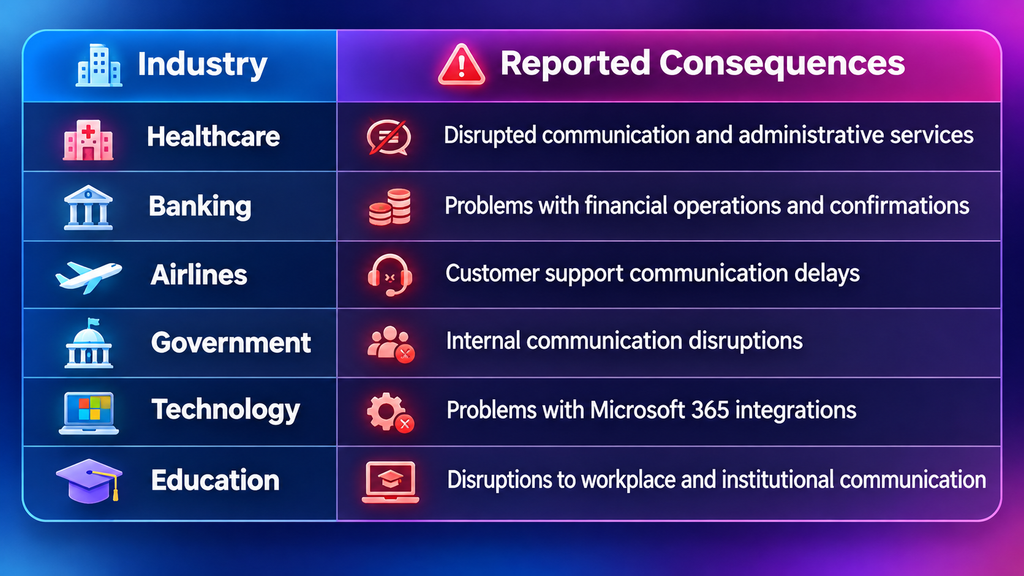
The impact varied between organisations. Not every institution experienced the same level of disruption.
Impact on artificial intelligence companies
The outage also affected integrations used by OpenAI and Anthropic.
This highlighted an important aspect of modern technology: companies do not need to operate their own email infrastructure to depend on Microsoft’s services.
When one cloud provider experiences a major failure, connected applications and third-party services can also experience interruptions.
This creates a chain of dependency across the technology industry.
One provider’s infrastructure problem can become another company’s operational problem.
Sources: Associated Press | Reuters
What Does This Mean for Microsoft’s Future?
Microsoft’s reputation depends heavily on the reliability of its products and infrastructure.
Businesses purchase Microsoft 365 because they expect dependable communication, collaboration, and productivity services.
A major outage raises an important question: Should organisations depend entirely on one technology provider?
However, switching enterprise platforms is not simple. Businesses already have contracts, employee workflows, integrations, training processes, and data dependencies.
Replacing an established technology ecosystem can be expensive and time-consuming.
The bigger challenge for Microsoft is maintaining customer confidence through:
- Better infrastructure resilience.
- More extensive testing of network changes.
- Improved server recovery procedures.
- Faster incident communication.
- Greater transparency through post-incident reports.
The outage also reinforces the importance of avoiding unnecessary dependence on a single provider for critical business operations.
What Should Businesses Learn From the Microsoft Outlook Outage?
The Microsoft Outlook outage offers five important lessons for businesses that depend on cloud-based services.
1. Maintain alternative communication channels
Keep emergency contact methods available. Phone calls, alternative email providers, and other communication channels can help teams coordinate during outages.
2. Protect critical information
Ensure essential documents, emergency procedures, and business information are accessible through appropriate backup arrangements.
3. Create a business continuity plan
Employees should know how to continue essential operations when email, collaboration tools, or cloud applications become unavailable.
4. Understand cloud dependencies
Identify which business applications depend on the same infrastructure provider. A single outage can affect multiple connected systems.
5. Test backup systems
A backup plan is useful only when it works during an actual disruption. Regularly test alternative communication methods and recovery procedures.
Cloud technology provides enormous benefits, but businesses should never assume that any provider will remain available 100% of the time.
Conclusion: One Outage, A Global Wake-Up Call
The November 2026 Microsoft outage was more than an interruption to Outlook.
It demonstrated how deeply modern organisations depend on shared cloud infrastructure.
A technical problem affected email communication, disrupted business operations, and exposed the risks of depending heavily on a single technology provider.
Although the total worldwide financial damage remains unknown, the estimated insured losses and widespread operational disruption demonstrate the importance of reliable digital infrastructure.
The incident also raises important questions about cloud reliability, business continuity, and the concentration of critical services among a small number of technology providers.
The biggest lesson is simple: Businesses should not only ask how reliable their technology provider is. They should also ask whether they can continue operating when that provider goes down.
Frequently Asked Questions About the Microsoft Outlook Outage 2026
Why did Microsoft Outlook go down in November 2026?
Microsoft attributed the disruption to a technical issue associated with an earlier network capacity upgrade and a subsequent network change. Server availability problems affected Exchange Online and other connected services.
How many countries were affected by the Microsoft outage?
Downdetector recorded reports from 74 countries and territories. This describes the geographical spread of reports, not the number of countries where every Microsoft service was completely unavailable.
How much money did the Microsoft outage cost?
Morningstar DBRS estimated global insured losses of approximately $300–500 million. Microsoft’s direct financial losses and the total worldwide economic impact have not been officially confirmed.
Was Microsoft hacked during the outage?
Microsoft said the incident was not related to a cyberattack or AI agents. Its investigation pointed towards a technical infrastructure issue.
Which Microsoft services were affected?
Outlook, Exchange Online, Microsoft Teams, Copilot, SharePoint Online, and other connected Microsoft 365 services experienced varying levels of disruption.
How long did the Microsoft outage last?
The disruption began on November 12, 2026, and continued into November 13. Broader recovery took time, with some services and users experiencing problems beyond the initial recovery period.
How can businesses prepare for future Microsoft outages?
Businesses should maintain alternative communication channels, prepare business continuity plans, protect critical information, identify cloud dependencies, and regularly test their backup arrangements.
Sources and References
The following publications and official resources provide reporting and information about the incident:
- Reuters – Microsoft’s global outage eases after disrupting businesses and governments
- Reuters – Faxes, phones and Bluetooth: Microsoft outage forces businesses to find fixes
- The Guardian – Microsoft scrambles to fix global outage affecting Teams and Outlook
- Associated Press – Microsoft outage exposes the risks of relying on one technology provider
- ABC News – Outlook outage: Microsoft reports issues with Teams and email
- Microsoft Service Health – Official service status
Reporting reflects information available as of November 14, 2026. Preliminary explanations, outage statistics, and financial estimates may be updated as additional information becomes available.